
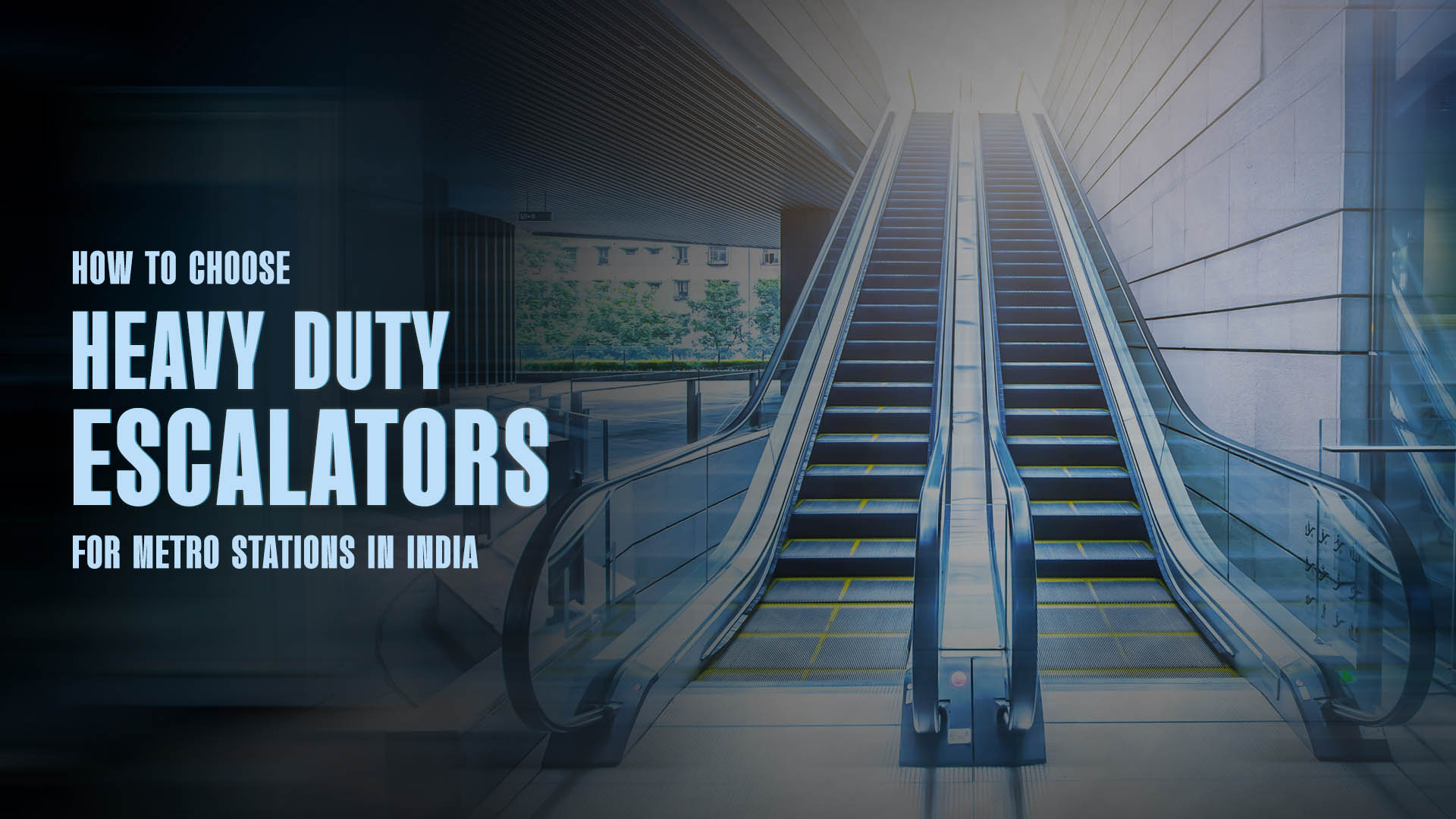
A metro escalator has a very different job from one in a shopping mall. It isn’t just moving people between two floors. It helps manage passenger flow at one of the busiest points in a public-transport system, often for long operating hours and under heavy, repeated loads.
Consider Ahmedabad Metro. During FY 2024-25, it recorded an average of 1,09,779 passenger journeys per day across Phases 1 and 2. That number can change dramatically during major events. Now consider Chennai Metro Phase II. Its current procurement includes dedicated contracts for the design, manufacture, supply, installation, testing, and commissioning of heavy-duty escalators for Corridors 3 and 5. The awarded contracts are valued at approximately ₹453.62 crore and ₹147.30 crore, respectively.
These examples highlight an important point: For metro infrastructure, an escalator isn’t an accessory. It’s critical passenger-movement equipment.
So, how do you choose the right heavy-duty escalators for metro stations in India?
1. Start With Passenger Flow, Not the Escalator
A metro station can have very different passenger patterns depending on its location. A station serving a residential area may experience a sharp morning peak. An interchange station may see heavy movement throughout the day. A station near a stadium, exhibition centre or commercial district can experience sudden passenger surges around events.
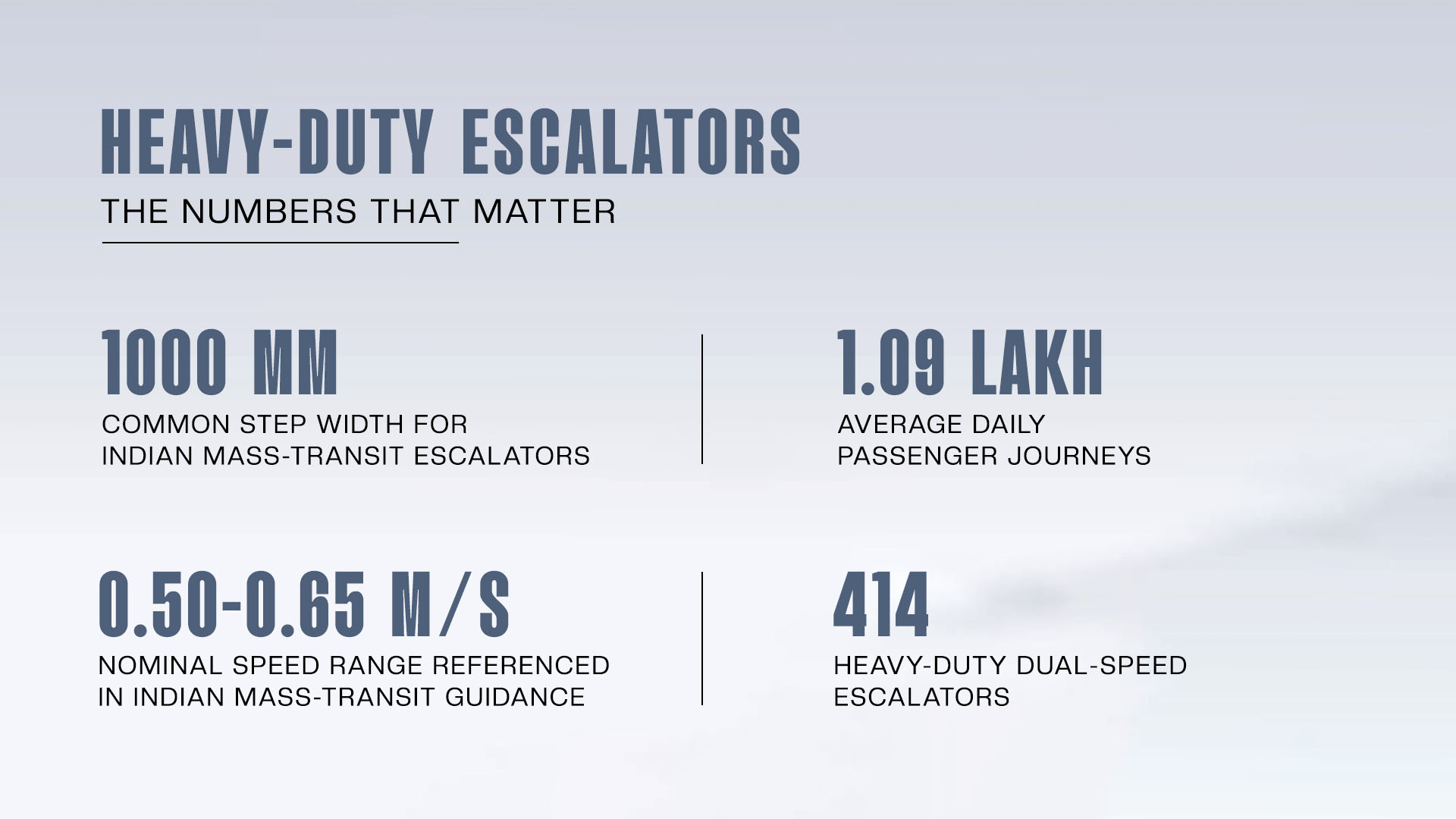
Ahmedabad Metro’s FY 2024-25 average of 1.09 lakh daily journeys is therefore useful context, but daily ridership alone isn’t enough to size an escalator system. The important consideration is how many passengers need to move in a particular direction during the busiest period.
The design should account for:
- Peak-hour passenger flow
- Direction of movement
- Platform-to-concourse traffic
- Concourse-to-street traffic
- Interchange movement
- Number and location of escalators
- Station evacuation requirements
This is why a manufacturer should be able to explain the passenger-flow calculation behind its proposed escalator capacity.
When passenger flow never stops, your escalators shouldn’t either.
Explore Heavy-Duty Escalator Solutions
2. Make Sure “Heavy Duty” Really Means Heavy Duty
The phrase heavy duty can sound like a marketing term. For a metro project, it should have a measurable engineering meaning.
Indian mass-transit standardization guidance specifies heavy-duty escalators for mass transit with a duty cycle of at least 20 hours a day, seven days a week, including alternating passenger loads reaching 100% of contract load for one hour and 50% for the following two hours. It also specifies features such as automatic lubrication and an auxiliary brake.
That’s a very different operating expectation from an escalator in a small office building. When evaluating an escalator, therefore, look beyond the motor rating or passenger capacity.
Check:
- Truss construction
- Step and chain design
- Drive system
- Rollers and bearings
- Braking arrangement
- Lubrication system
- Corrosion protection
- Continuous-duty capability
The real question is: Can the system repeatedly handle demanding passenger loads without becoming a reliability problem?
3. Get the Step Width and Speed Right
In a metro station, passenger throughput depends on more than simply making an escalator faster. Indian mass-transit standardization guidance specifies a 30° inclination, 1000 mm step width, and nominal speeds of 0.50 m/s and 0.65 m/s for heavy-duty mass-transit escalators. These parameters matter because the escalator has to move passengers efficiently while maintaining a predictable and comfortable flow.
Indian Railways’ technical specification provides another useful reference: for a 1000 mm step width and 0.5 m/s nominal speed, it specifies a maximum carrying capacity of 100 passengers per minute for its heavy-duty railway-station escalator configuration. The important word here is configuration.
A capacity number should never be viewed in isolation. Step width, speed, passenger behaviour, installation conditions, and the project’s applicable specifications all influence the final design.
So when comparing proposals, ask: “What configuration and calculation support this passenger-capacity figure?”
4. Design for Where the Escalator Will Actually Operate
A metro escalator in an underground station doesn’t face the same conditions as one at an elevated or semi-outdoor station. Depending on the location, the equipment may have to deal with: Dust. Heat. Humidity. Rain. Pollution. Corrosion.
Indian Railways’ heavy-duty escalator specification specifically addresses semi-outdoor applications and requires protection against the ingress of water and dust so that exposed components don’t suffer deterioration affecting reliability. This is why construction and material selection matter.
Techno Elevators uses a high-strength, anti-corrosion steel truss in its commercial escalator systems, along with stainless-steel components and large-diameter rollers designed to support durability and quieter operation.
5. Safety Needs to Work at the Component Level
Imagine an evening peak at a busy interchange. Passengers are carrying bags. Some are moving quickly. Others are travelling with children or elderly family members. An escalator safety system has to account for far more than normal operation.
Important protections include:
- Overspeed protection
- Anti-reversal protection
- Emergency stop systems
- Handrail entry protection
- Step-collapse protection
- Roller rupture protection
- Comb-plate protection
- Automatic braking
- Fault indication
Indian mass-transit guidance calls for operating and safety devices in accordance with EN 115, along with an auxiliary brake for heavy-duty escalators. Techno’s escalator systems include 30+ safety features, including overspeed and auto-reversal protection, step-collapse and roller-rupture protection, emergency controls and fault indicators. But safety shouldn’t end with the feature list.
During procurement, ask how those systems are tested, monitored, and maintained over the equipment’s operating life.
Planning the next high-traffic transit destination?
Find the Right Escalator Solution
6. Choose Monitoring That Helps Reduce Downtime
For a metro operator, an escalator breakdown isn’t merely an inconvenience. It can alter passenger circulation around the station. This is where monitoring and diagnostics become useful.
Techno’s escalator systems use a control board to monitor operation in real time, record malfunction codes, and automatically apply braking when abnormalities are detected. This kind of capability becomes particularly valuable across a large metro network, where maintenance teams need to identify problems quickly instead of waiting for a passenger-flow disruption to reveal them.
The objective is simple: Detect the problem. Identify the cause. Respond quickly.
For project teams, this means monitoring capability should be evaluated alongside the mechanical specification, not treated as a decorative “smart” feature.
7. Think About Energy Use During Low-Traffic Periods
Metro stations don’t experience peak passenger movement all day. So why operate an escalator at full speed when passenger demand is low?
Modern escalators can use variable-speed technology to adapt operation to changing traffic conditions.
Techno offers VVVF control as an option, which can adjust running speed and support energy-efficient operation during lower-demand periods.
This approach has already appeared in Indian metro infrastructure. Mumbai Metro Line 3, for example, deployed 414 heavy-duty dual-speed escalators with regenerative energy-saving mode for its underground stations.
That’s a useful reminder that energy efficiency doesn’t have to mean compromising passenger movement.
It can mean using the right amount of power for the traffic condition.
What a Metro Escalator Project Actually Involves
One reason metro escalator procurement is different from ordinary commercial projects is the scope involved.
Look at Chennai Metro Phase II.
Its heavy-duty escalator packages cover: Design → Manufacture → Supply → Installation → Testing → Commissioning
And the contracts aren’t isolated equipment purchases; they form part of a much larger transit-infrastructure programme. That means the manufacturer needs to be evaluated not only on the escalator itself, but also on its ability to execute the complete project.
Before selecting an escalator manufacturer in India, look at:
- Engineering capability
- Manufacturing capability
- Installation experience
- Testing and commissioning
- Project coordination
- Spare-parts availability
- Preventive maintenance
- Breakdown support
- Long-term service capability
The best equipment can still become a weak infrastructure investment if the support system behind it isn’t reliable.
A Practical Checklist for Choosing Metro Escalators
Before approving a heavy-duty escalator proposal, ask:
| What to Check | Why It Matters |
| Peak passenger flow | Determines actual system capacity |
| Step width | Influences passenger throughput |
| Operating speed | Affects flow and travel time |
| Duty cycle | Establishes continuous-use capability |
| Truss & components | Determines structural durability |
| Environment | Protects against dust, heat, water, and corrosion |
| Safety systems | Protects passengers during abnormal conditions |
| Monitoring | Helps identify faults faster |
| Energy efficiency | Controls long-term operating costs |
| Maintenance | Reduces prolonged downtime |
| Spare parts | Supports long-term serviceability |
| Compliance | Ensures alignment with applicable standards |
The Right Escalator Should Disappear Into the Journey
Passengers shouldn’t have to think about an escalator.
- They step on.
- They move.
- They step off.
For that simple experience to happen thousands of times a day, the equipment underneath needs to be anything but simple. The right heavy-duty escalators for metro stations need to combine passenger-flow capacity, continuous-duty performance, safety, environmental durability, intelligent monitoring, energy efficiency, and dependable maintenance.
And the right manufacturer needs to bring more than a machine to the project. It needs to bring engineering, installation, testing, commissioning, and long-term support.
Techno Elevators develops commercial escalator systems for high-traffic environments, including transit stations, with features such as anti-corrosion construction, real-time monitoring, automatic lubrication, multiple safety systems, and optional VVVF control.
When thousands of passengers are moving, the escalator shouldn’t be the bottleneck. It should be the reason the movement feels effortless.
Frequently Asked Questions
1. What makes an escalator suitable for a metro station?
Metro escalators need to support high passenger volumes and prolonged operating hours. They should be designed for heavy-duty operation and include appropriate safety, monitoring, durability, and maintenance provisions.
2. What step width is commonly used for metro escalators in India?
Indian mass-transit standardization guidance specifies a 1000 mm step width for heavy-duty escalators, alongside a 30° inclination and nominal speeds of 0.50 m/s and 0.65 m/s. The final specification depends on the project requirements and applicable standards. Ministry of Housing and Urban Affairs
3. How are metro escalators different from regular commercial escalators?
The major difference is the expected duty cycle and passenger demand. Metro escalators are designed for sustained, high-frequency public-transport use and need stronger consideration of passenger flow, safety, environmental exposure, monitoring, and long-term maintenance.
4. Why is VVVF control useful in metro escalators?
VVVF control can allow the escalator’s speed to be adjusted according to operating conditions. This can support more efficient operation during lower passenger-demand periods.
5. What should I check before choosing an escalator manufacturer in India?
Look beyond the equipment price. Evaluate engineering capability, applicable standards, manufacturing quality, safety systems, testing and commissioning capability, spare-parts availability, maintenance support, and experience with high-traffic applications.
Planning a metro, railway, or high-traffic transit project?
Learn the key differences between firefighter elevators and regular elevators, their safety features, emergency use, and how to identify them in buildings.
