
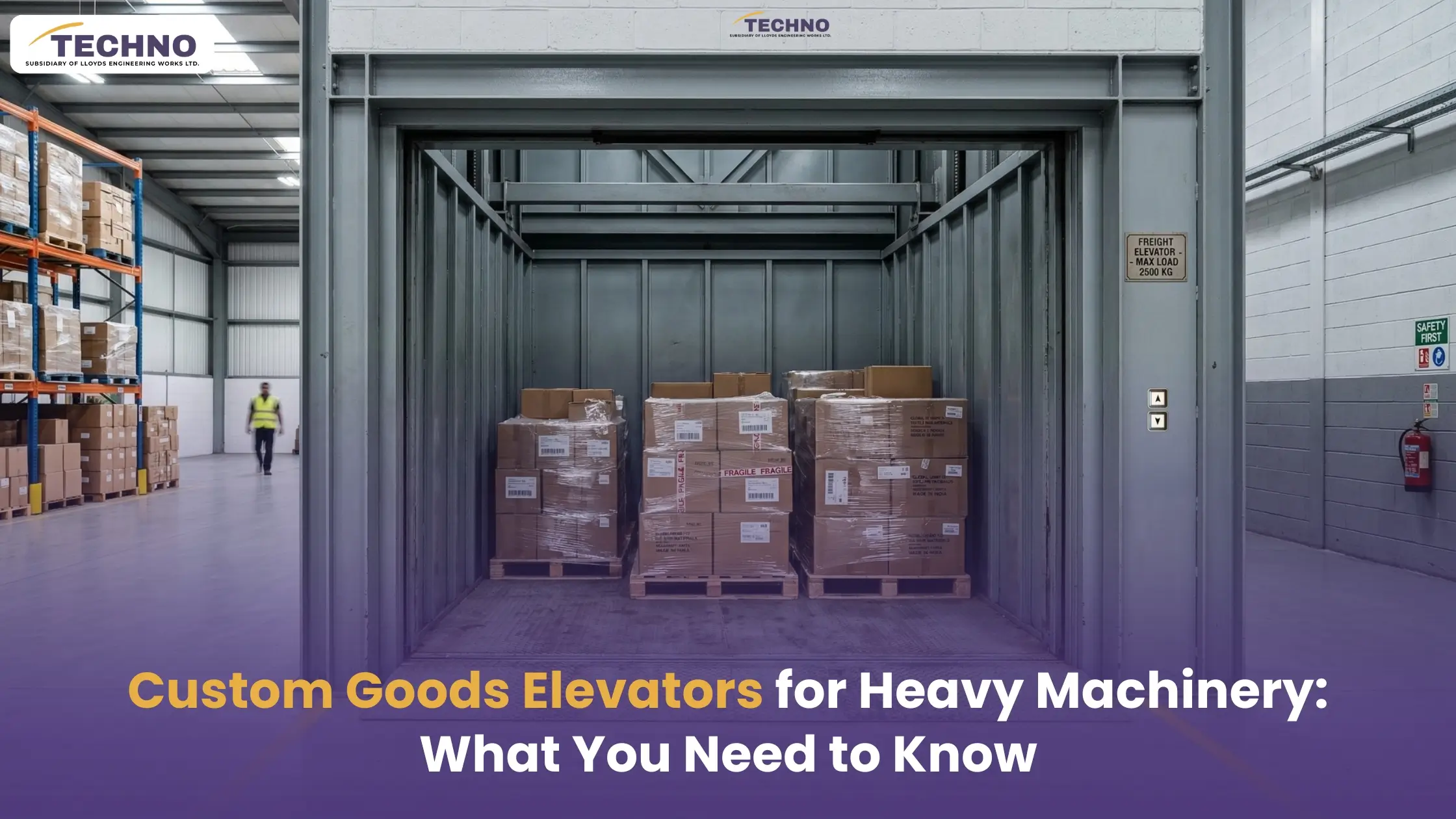
Moving heavy machinery vertically inside a factory, warehouse, or industrial facility is one of those problems that doesn’t get solved well with off-the-shelf equipment. A standard Goods Elevator designed for packaged goods or pallets is not the same thing as a system built to handle a 10,000-kilogram industrial press, precision manufacturing equipment, or automotive components on a production floor.
The load profiles, structural requirements, drive systems, and safety considerations are different enough that custom engineering is not optional — it’s the starting point.
Why standard goods elevators fall short for heavy machinery
Off-the-shelf goods elevators in India are typically rated for loads between 500 kg and 5,000 kg. That covers most warehouse and distribution center applications. But industrial heavy machinery transport can exceed this significantly — in specialized applications, custom industrial lifts are engineered to handle loads of 10,000 kg and beyond.
The gap isn’t just about weight ratings on a specification sheet:
- A lift designed for heavy machinery needs a reinforced platform floor that won’t flex or deform under load
- The loading method matters — machinery loaded by forklift creates different dynamic forces than hand-loaded cargo
- Drive systems, brake mechanisms, and guide rail systems all need to be sized for actual impact loads, not just static weight
Using a standard goods elevator for machinery that exceeds its rated capacity isn’t just an operational risk — it accelerates mechanical wear on every system in the lift and creates a serious safety liability.
Understanding load capacity and weight management
Load capacity specification for a custom goods elevator should account for three things:
- The maximum single-item weight to be transported
- The weight of any loading equipment (forklifts, trolleys) that will travel with the load
- A safety margin above the operating maximum
ASME A17.1 freight elevator classifications offer a useful framework:
- Class A / Class B — for loads distributed across the platform; typically how machinery is transported
- Class C1 — designed for industrial truck loading; forklifts drive onto the platform with their load
- Class C2 — allows loading at up to 150% of stated capacity for specific loading operations
In Indian industrial settings, IS 14665 under the Bureau of Indian Standards (BIS) provides the applicable specifications for electric traction lifts. A qualified engineer should verify that load specification and safety factors comply with the relevant standard for the installation.
Hydraulic versus traction systems for heavy-duty applications
This is the decision that has the most practical consequence for heavy industrial use.
Hydraulic goods elevators use a fluid-driven piston to raise and lower the platform:
- Best suited for low-rise applications — typically two to five floors
- Offer smooth operation and good load stability
- Natural load-holding capability: if power is interrupted, the platform holds position rather than dropping — an important safety characteristic for heavy machinery
- Limitations: slower travel speeds (typically 25 to 50 feet per minute under heavy load), reduced energy efficiency compared to traction alternatives, and require regular monitoring for oil leaks and seal integrity
Traction goods elevators use wire ropes, sheaves, and counterweights driven by an electric motor:
- Handle higher speeds, greater travel heights, and can be more energy-efficient over time
- Better suited for multi-floor industrial buildings where the elevator runs at high frequency with significant loads
- Tradeoffs: require machine room space (or an MRL configuration for certain capacity ranges), rope maintenance schedules, and more sophisticated control systems; counterweight calculation needs to account for load variance across trips
Neither system is universally better. The choice should follow from a proper assessment of travel height, frequency of use, load profile, and facility layout.
Structural and design requirements for custom elevators
The cage size for heavy machinery elevators is usually the first design parameter to establish. Platform size ranges:
- Standard light industrial: roughly 1.5 x 2 metres
- Automotive and heavy manufacturing applications: 4 x 5 metres or larger
For machinery that cannot be disassembled, the platform must accommodate the full assembled footprint plus the clearances required for loading equipment.
Door opening configuration matters too. Heavy machinery is typically loaded by forklift, which means the access opening needs to be wide enough for the fork spread plus the machinery width, and tall enough for the load height with the forks raised. Many industrial goods elevator designs use full-width opening doors or bi-parting options to maximize the usable opening.
Platform decking for heavy machinery transport is typically steel plate, with reinforcement sizing calculated from the concentrated load points created by forklift tyres and machinery support feet — not a distributed load assumption.
Safety features for industrial goods elevators
A custom goods elevator for heavy machinery should include:
- Overload protection with interlock — load cells in the platform floor or suspension system measure actual load before travel is permitted; this should physically prevent the elevator from moving, not just alert the operator
- Anti-fall devices and governor-triggered safety brakes — mandatory; for hydraulic systems, a pipe fracture valve prevents the platform from dropping if a hydraulic line fails; for traction systems, mechanical safety gear engages if the cab exceeds a preset overspeed threshold
- Door interlocks — prevent movement when any access door is open
- Gate interlocks and light curtains — additional protection at entry points for industrial operations where workers may be in the vicinity of the platform during loading
Accessible emergency stop buttons — at the cab and all loading points; clearly marked and physically accessible, not tucked inside a control cabinet
Maintenance for long-term performance
A high-capacity custom goods elevator running in a production environment can accumulate a lot of cycles. The maintenance schedule should be more frequent than for lighter-duty applications.
For hydraulic systems:
- Fluid level checks and seal inspection
- Pump condition monitoring
- Filter replacement on a set schedule
- Inspection for oil leaks at all connections and the reservoir
For traction systems:
- Rope inspection for wear and fraying
- Sheave groove condition
- Motor brush condition
- Brake lining wear
For both system types:
- Guide rail lubrication
- Platform floor inspection for deformation
- Annual overload sensor calibration
In regulated industries — pharmaceutical manufacturing, food processing, automotive — maintenance records may be subject to external audit. Each visit should be documented with specific findings, component condition notes, and any parts replaced.
Choosing the right manufacturer and supplier
Specifying a custom goods elevator for heavy machinery is not a transactional purchase. The manufacturer needs to understand the operational context: what’s being moved, how often, by what method, and in what environment.
Key questions to ask any supplier:
- What is the maximum single-point load they have designed for?
- Can they provide reference installations in comparable industrial settings?
- What is their post-installation service capability in your region?
- Do their designs comply with IS 14665 and the relevant BIS standards?
Price is a factor, but the wrong specification on a high-capacity industrial lift creates costs — in repairs, downtime, and potential liability — that dwarf any savings on the initial procurement.
In a busy commercial environment, a goods lift is not just another piece of machinery, it is an important link in your …
