Introduction
Space is tight. Anyone who’s tried squeezing ramps into a dense urban plot knows that feeling. You buy land at ₹25,000 per sq. ft., then burn a chunk of it just to let cars spiral up and down. It’s too much painful. Here’s the thing: Car Elevators exist just because that math doesn’t make sense anymore. They’re an automobile elevator system designed to move vehicles vertically, cleanly, safely, without eating up sellable or rentable area.
We’ve watched projects in Mumbai, Ahmedabad, and even Pune, claw back 800–1,200 sq. ft. per building simply by ditching ramps. That’s real money. Here, the car lift mechanism explained in this blog.
This piece breaks down how car elevators work, step by step. Not brochure talk. Actual mechanisms, loads, pressures, and controls. Why understanding the mechanism matters for ROI, safety, and long-term maintenance. Are you planning a building? This stuff decides whether your parking solution becomes an asset — or a headache.
What Is a Car Elevator? Definition & Purpose
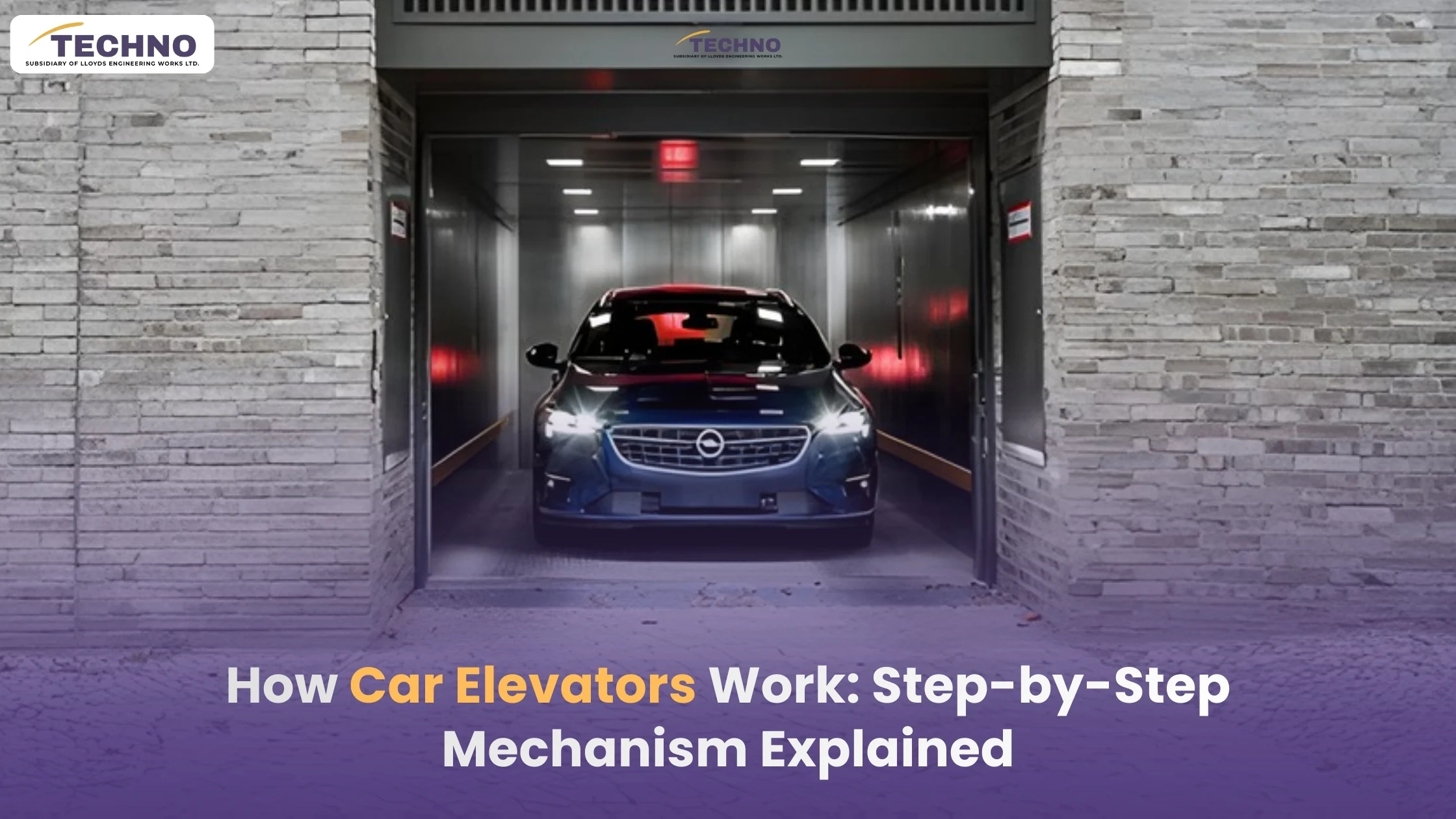
At its core, a car elevator is a lift engineered to transport vehicles — not people — between floors. Different loads. Different forces. Different risks. In simple terms, Car Elevators replace or supplement ramps in residential towers, commercial buildings, showrooms, and villas. Instead of burning horizontal space, you go vertical.
This automobile elevator system allows cars to drive onto a platform, move up or down, then exit on another level. No circling. No wasted area. Why do developers like them? Because one lift shaft (say 25–30 sq. m.) can replace a ramp consuming 300–500 sq. m. That delta directly improves FAR utilisation and property value. Purpose isn’t convenience alone. It’s efficiency. And, frankly, smarter engineering.
Key Components of a Car Elevator System
Every system looks simple from the outside. Inside? It’s tightly choreographed hardware. Core car elevator components include:
- Platform / Carriage: The steel platform that holds the vehicle. Typical size? Around 5.5 m × 2.6 m. Designed for SUVs. Load ratings are usually 2,000–3,000 kg.
- Guide Rails & Frame: Heavy-duty rails (often IS 2062 steel) keep the platform aligned. No sway. No tilt.
- Drive Mechanism: Either a hydraulic pump with a cylinder or an electric motor with ropes and a sheave.
- Control System: PLC-based logic (Siemens or Schneider is common) managing movement, doors, and safety checks.
- Doors / Gates: Full-height swing or sliding gates with electromechanical interlocks.
- Safety Gear: Mechanical brakes, buffers, overspeed protection, hydraulic check valves.
Details vary by type. Which brings us there.
Types of Car Elevators: Hydraulic vs Traction
Not all car elevators behave the same. Choosing wrong can cost you later.
Hydraulic Car Elevators
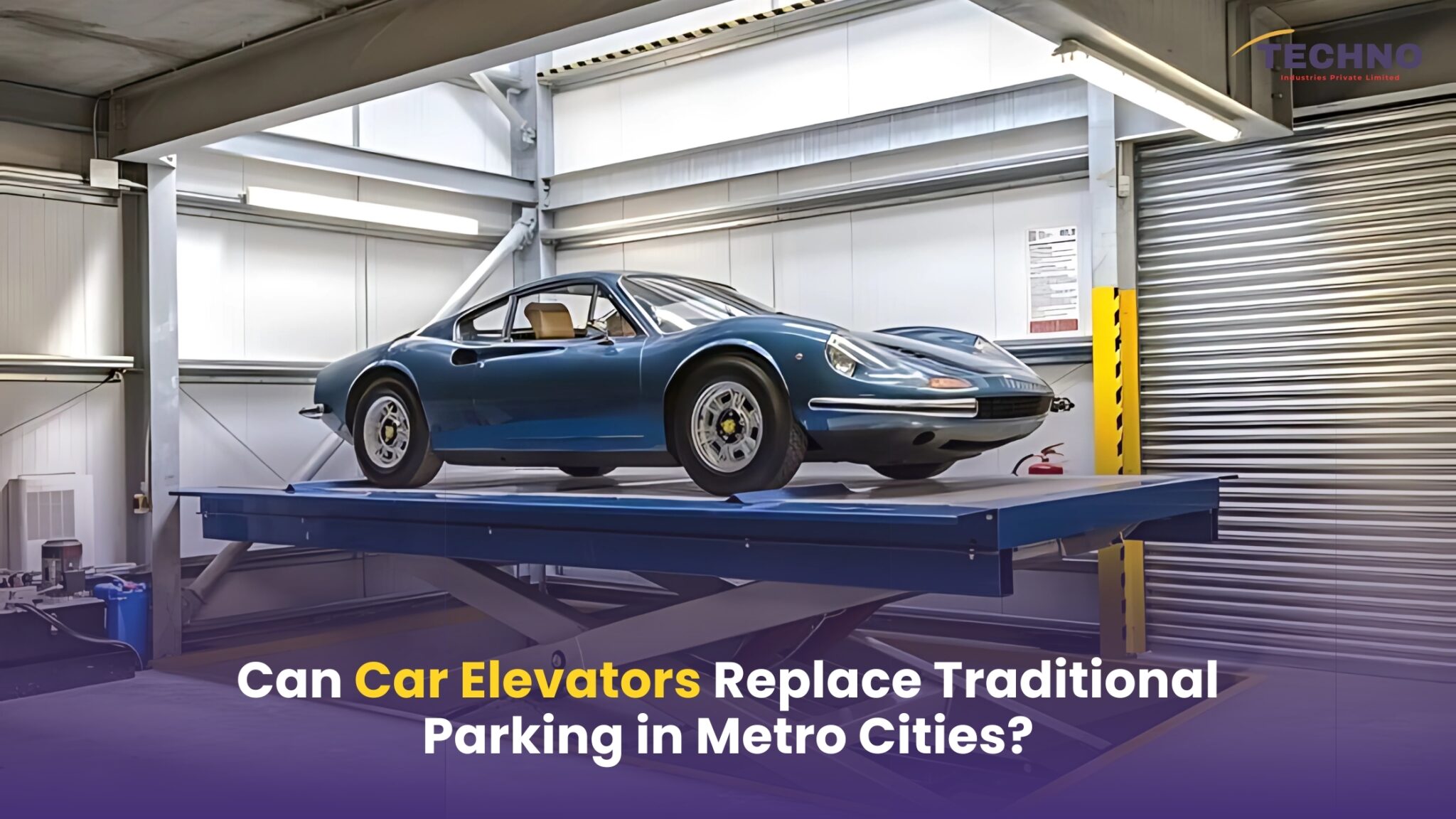
A hydraulic car elevator uses fluid power. A pump pushes oil into a cylinder, lifting the platform. Pressure levels? Typically 200–250 bar.
Why people choose them:
- Excellent for 2–4 floors
- Handles heavy loads (3,000 kg isn’t unusual)
- No overhead machine room required
Speed is modest — around 0.15 to 0.25 m/s. That’s fine for parking. Downsides? You need a pit (600–1,000 mm), and oil systems demand disciplined maintenance. Modern seals reduce leak risks… but neglect still bites.
Traction Car Elevators
A traction car elevator runs on an electric motor, steel ropes, and a counterweight. Think classic elevator physics.
Strengths:
- Faster travel (0.3–0.6 m/s)
- Better for 5+ floors
- Lower energy draw over repetitive cycles
Trade-off? Higher upfront cost. More components. Overhead space is mandatory. Truth is — hydraulics shine at low-rise. At taller heights, traction usually wins. Depends on the project. Always does.
Step-by-Step Working Mechanism of a Car Elevator
This is the car elevator working mechanism, stripped of fluff.
- Entry
The vehicle drives onto the platform. Laser or proximity sensors confirm alignment. Miss the center badly? System won’t proceed. - Securing
Doors and gates close. Interlocks engage. Weight sensors verify load — 2,500 kg rated means 2,500 kg max. No negotiation. - Lift Motion
Hydraulic: Motor starts. Pump pressurizes oil. Cylinder extends. The platform rises.
Traction: The motor rotates the sheave. Ropes move. Counterweight balances the load. - Travel
Acceleration is ramped. PLC smooths the jerk. You barely feel motion. That’s deliberate. - Arrival & Leveling
Sensors stop the platform within ±5 mm of floor level. Precision matters — especially for low-clearance cars. - Exit
Doors open. Vehicle drives out. Cycle complete.
That’s the car lift operation process. Simple on paper. Ruthless in execution if poorly engineered.
Car Elevator Control System & Automation
Brains matter more than muscles. Modern systems rely on PLCs — Siemens S7 is common — with redundant inputs. Call buttons trigger logic sequences. If one door doesn’t confirm “locked,” the lift doesn’t move. Period.
Automation covers:
- Door sequencing
- Speed control via VFDs
- Emergency stop logic
- Overload detection
Some installations integrate remote monitoring into BMS dashboards. You see faults before users do.
Press a button…and the logic takes over. Quietly. Reliably. That’s good engineering.
Load Capacity, Size & Design Requirements
Let’s talk numbers. Real ones.
Typical capacities range from 1,500 kg to 3,000 kg. Luxury homes usually spec 2,000 kg. Commercial? 2,500–3,000 kg.
Platform dimensions average 5–6 m long and 2.4–2.8 m wide. Door height often hits 2.2 m to clear SUVs.
Design elements in car elevator design include:
- Pit depth: 600–1,000 mm
- Foundation slab: ~300 mm RCC, designed for 10–15 tons
- Overhead clearance: Critical for traction systems
Ignore civil coordination, and you’ll pay later. Always do.
Safety Features Used in Car Elevators
No shortcuts here. Ever.
A robust car lift safety system includes:
- Mechanical brakes for overspeed
- Hydraulic rupture valves (lock on hose failure)
- Emergency lowering via manual valve or battery backup
- Overload cut-offs
- Door/gate interlocks
- Buffers in the pit
- Fire recall integration (as per local codes)
Standards matter. ISO 18738-2. EN 81-41. IS 14803 in India. At Techno, every safety device is tested during commissioning. Safety isn’t optional.
Car Elevator Installation Process Explained
Installation isn’t guesswork.
- Site Survey & Design
Measurements. Load paths. Entry geometry. - Civil Work
Pit excavation. Foundation casting. Usually 7–10 days. - Equipment Delivery
Rails, platform, machinery — prefabricated. - Assembly
Rails first. Platform next. Drive unit installation. - Electrical & Hydraulic Hookup
Power, controls, piping. - Testing & Commissioning
Load tests — often 125% to 300% rated capacity. Safety checks. Certification.
Total timeline? Roughly 3–4 weeks. Modular systems can shave 20%. Zero Downtime isn’t a slogan — it’s planning.
Common Applications of Car Elevators (Residential & Commercial)
You’ll find car parking lift working solutions in:
- Luxury villas with basement parking
- High-rise residential towers
- Car showrooms are stacking display vehicles
- Hotels using valet parking underground
- Dense commercial developments
One shaft. Multiple use-cases. Flexible by design.
Maintenance, Inspection & Compliance Standards
Maintenance keeps theory alive in practice. Monthly inspections check oil levels, ropes, sensors, and brakes. Quarterly servicing handles lubrication and adjustments. Annual inspections renew certification. Non-compliance isn’t cheap — fines can hit ₹25,000 to ₹2 lakh per elevator in India.
Standards like IS 14803 and EN 81-41 govern operations. Documentation matters.
We maintain detailed logbooks. Every visit. Every fault. That discipline underpins reliability.
Conclusion
Car Elevators aren’t indulgences. They’re space assets. Swap a ramp for a lift in a five-story building, and you might free 1,000 sq. ft. — worth lakhs annually in rent or sale value. That’s the business case.
With 30+ years in vertical mobility, we’ve seen what works and what quietly fails later. Our zero-downtime mindset comes from that experience. If you’re planning a project and want a parking system that pays back — not one that nags — talk to Techno Elevators. A car elevator isn’t just machinery. It’s an engineered breathing room.
As our cities become more vertical and streets become busier, a simple yet troubling question is on the minds of urban planners, …