
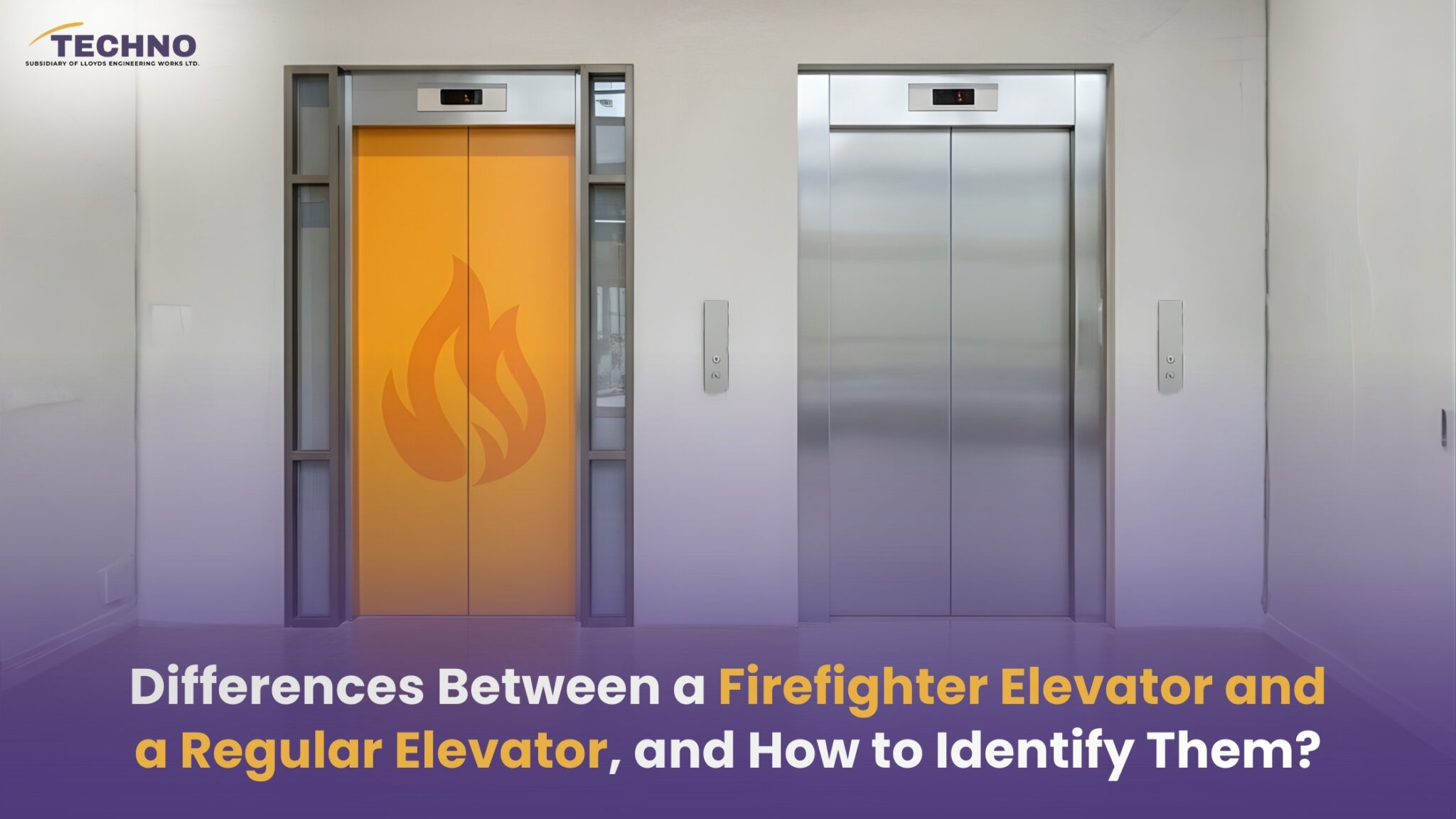
Introduction to Firefighter Elevators and Their Purpose
The vast majority of building occupants never consider elevators until there is something wrong with them. Whenever there is a fire alarm, the confusion occurs within a few minutes – cars reappear in the lobby regardless of the time, the call buttons cease to register, and the signs just no longer seem sufficient. Why does one elevator disappear from service while another remains available to emergency crews?
That behavior is not random. It is the result of deliberate engineering choices shaped by decades of fire incidents, evolving codes, and hard operational lessons. At Techno Elevator, this misunderstanding shows up repeatedly during audits and post-installation reviews. Occupants assume all elevators function the same way. They don’t. Not even close.
The distinction between a firefighter and an ordinary elevator lies at the root of the problem, and comprehending the reason behind such a distinction is essential to building professionals as well as fire safety staff.
Key Differences Between Firefighter Elevators and Regular Elevators
A regular elevator serves convenience. It moves people efficiently during normal conditions. That is its job.
A firefighter elevator exists for a completely different reason: to support emergency response when conditions are actively hostile – heat, smoke, water intrusion, and unstable power included. That single distinction drives every design decision that follows.
During a 2019 third-party review at a 40+ story commercial tower in Mumbai, Techno Elevator engineers encountered a familiar issue. The building had labeled a standard passenger car as a “fire lift” based solely on signage. Structurally and electrically, it could not operate safely once emergency power was engaged. This scenario appears in a majority of legacy high-rise evaluations.
Purpose defines performance. Emergency elevators are built for worst-case scenarios. Regular elevators are not.
Capability is the most apparent difference. Fighting lifts are usually a higher-capacity load – usually 3,500 lbs and so on – to support crews, breathing gear, hose bundles, and stretchers. The standard elevators are not designed to support emergency logistics but to accommodate people.
Power supply marks another critical divide. Firefighter elevators connect to dedicated emergency power through protected routing. Cabling follows fire-resistance requirements, often exceeding one- or two-hour ratings. This is explicitly addressed in IS 17900 series. Regular elevators generally shut down when normal power is lost.
Then there is fire resistance. A Fire Resistant Elevator incorporates rated hoistways, reinforced landing doors, protected machine spaces, and water-tolerant components. These elements allow continued operation even as sprinkler systems activate and smoke migrates through the building.
That resilience is intentional. Firefighter elevators are designed to function when the building is already under stress.
Safety Features Unique to Firefighter Elevators
Many elevator safety features sound impressive on paper. Only a few truly matter during an emergency.
Hoistway and lobby pressurization reduce smoke infiltration, but only when correctly balanced. Excessive pressure prevents doors from opening. Insufficient pressure allows smoke to flood the shaft. Codes insist on tight tolerances here for a reason – visibility and breathable air directly affect response speed.
Wiring protection matters just as much. Fire-rated insulation, sealed junctions, and protected control panels keep systems alive when heat levels rise. Communication systems in firefighter elevators connect directly to the fire command center, not a remote call service.
Backup power is not optional. It must carry the elevator under full load. In multiple facility assessments conducted by Techno Elevator between 2017 and 2023, emergency generators passed acceptance testing, yet elevator transfer switches failed during live simulations. Documentation looked compliant. Reality was different.
That gap is where risk lives.
Emergency operations: Phase I and Phase II are not negotiable
Elevator operation during fire conditions revolves around two mandated modes.
Phase I recall automatically returns elevators to a designated landing – usually the main lobby – and removes them from public use. This prevents occupants from unknowingly traveling toward danger.
Phase II operation places the elevator under direct firefighter control from inside the cab. Hold-to-run buttons, manual door operation, and override logic allow responders to manage movement precisely. Integration with the fire command center is mandatory under IS 14665 for qualifying high-rise buildings.
When these controls are unclear, response slows. During a 2021 integrated fire drill at a healthcare facility, mislabeled Phase II controls caused hesitation among crews unfamiliar with the layout. The issue wasn’t equipment failure. It was design clarity – or lack of it.
Design and Structural Differences in Firefighter Elevators
Firefighter elevators are physically different.
Cab dimensions accommodate stretchers without contortions, typically requiring clear depths of 78–84 inches. Door widths allow equipment entry without delay. Hoistways often carry two-hour fire ratings, and protected lobbies or vestibules isolate smoke migration.
Regular elevators lack these features because they were never intended to operate during suppression activities.
Fire safety elevator systems treat smoke as the primary enemy. Without proper lobby separation and pressurization, shafts become vertical chimneys. Codes reflect that reality because history demanded it.
Identification Tips: Signs and Labels to Spot Firefighter Elevators
Identification begins with signage. Many jurisdictions require a firefighter helmet symbol at designated landings. Control panels inside the cab include key switches labeled for firefighter operation.
But signage alone proves nothing.
True identification comes from specifications, inspection records, and compliance documentation. Capacity plates, emergency power labeling, communication routing, and generator performance under load all matter.
Techno Elevator assessments routinely uncover elevators labeled for emergency use that fail one or more of these criteria. Appearance can mislead. Documentation does not.
Regulatory Standards Governing Firefighter Elevators
IBC Section 3007 defines firefighter elevator requirements based on building height and occupancy. National Building Code of India (NBC) governs mechanical and operational safety. NFPA standards influence alarm integration, power reliability, and testing frequency.
These elevator compliance standards evolved from real failures. Every requirement addresses a past incident where systems didn’t perform as expected.
Why higher capacity? Why protected wiring routes? Why pressurized lobbies? Because people were injured when those elements were missing.
Common Misconceptions About Firefighter vs. Regular Elevators
Several myths persist despite clear evidence:
- Firefighter elevators are safe for occupant evacuation. They are not.
- All elevators in new buildings qualify. Only designated systems do.
- Fire resistance means fireproof. It does not.
- Sprinkler activation disables emergency elevators. Properly designed systems tolerate water.
- Regular elevators can substitute in emergencies. They cannot.
- Annual testing alone ensures readiness. It doesn’t.
- Signage guarantees compliance. It never has.
These assumptions create complacency, and complacency fails under pressure.
Maintenance and Inspection Requirements for Firefighter Elevators
Monthly testing identifies degradation early. Annual inspections verify continued compliance. In a multi-year review of commercial properties, Techno Elevator found that facilities skipping routine emergency testing showed nearly three times the rate of critical failures during live simulations.
A Fire Resistant Elevator does not remain resistant forever. Seals age. Pressurization fans drift. Electrical connections corrode. Maintenance keeps theory aligned with reality.
Real outcomes from real buildings
In 2018, a high-rise office building experienced a multi-floor electrical fire. Firefighter elevators remained operational due to compliant emergency feeder routing and protected controls. Crews reached upper levels faster. Fire spread was limited. Post-incident analysis estimated damage reduction of nearly 30% compared to similar structures.
In contrast, a residential tower evaluated in 2020 lacked compliant lobby pressurization. Smoke entered the hoistway. Elevators shut down. Stair-only access delayed response. Injuries followed.
Same city. Different preparations.
Why this distinction still matters
Firefighter elevators exist because stairs alone cannot meet every emergency demand. Regular elevators support daily life. Emergency elevators support the moments that define safety outcomes.
Understanding the difference between a Fire Resistant Elevator and a standard system is not academic. It is operational knowledge rooted in codes, incidents, and experience.
At Techno Elevator, this distinction guides every design review, audit, and compliance recommendation. Because when alarms activate, systems must behave exactly as intended – or the building pays the price.

Learn how smart technology is transforming flameproof elevators by improving safety, real-time monitoring, and performance in hazardous environments.
