
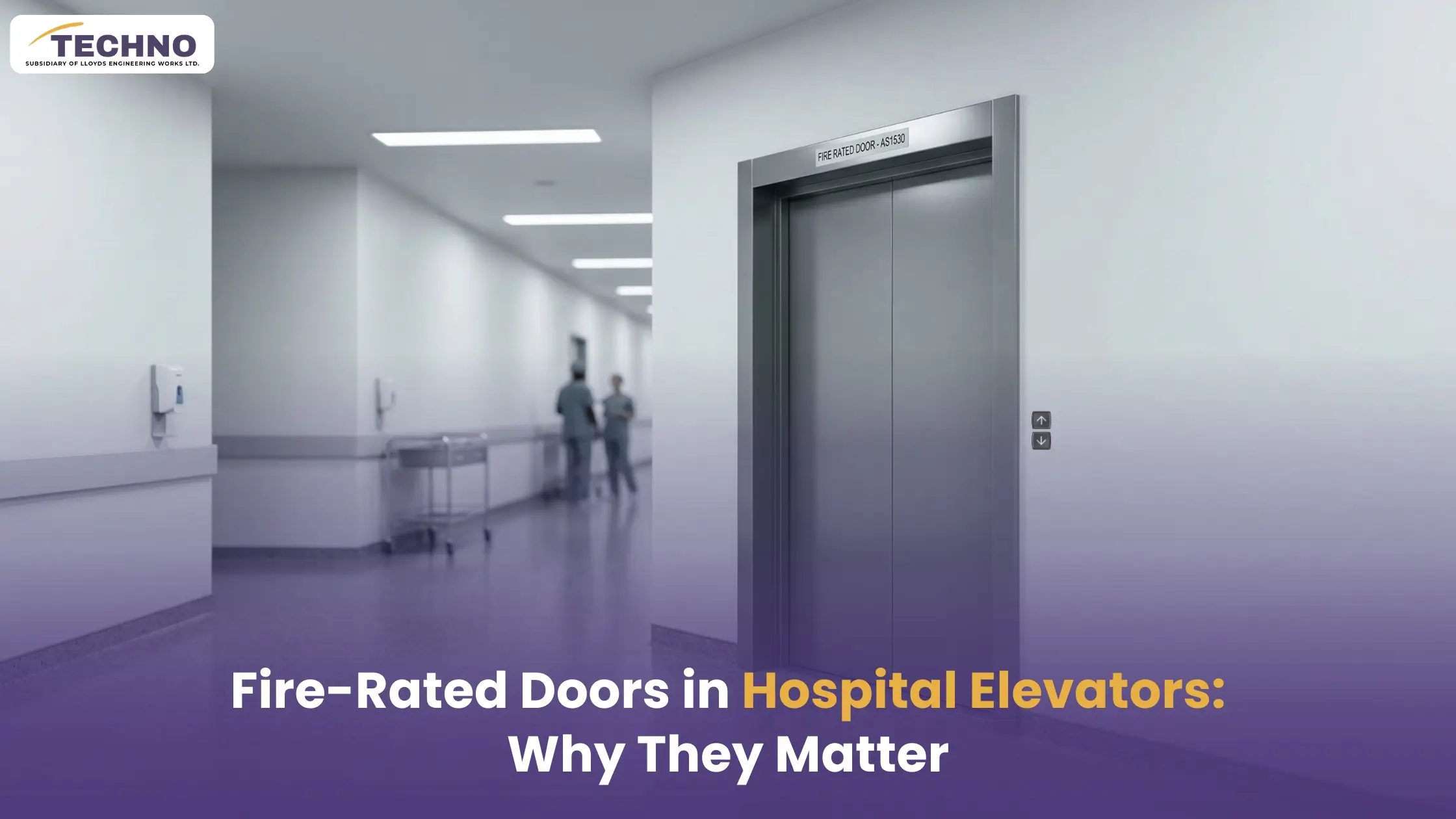
Hospitals are one of the most demanding environments for fire safety — not because fires are more common in them, but because the consequences of one are uniquely severe. Patients on ventilators cannot evacuate quickly. ICU and surgical unit occupants can’t use stairs. In a building where large numbers of people physically cannot leave under their own power, the design of the building itself has to buy time.
Fire-rated doors on Hospital Elevators are a core part of that system. Yet they’re also among the most frequently cited compliance failures in healthcare facility inspections. Anyone responsible for managing hospital vertical transport needs to understand what these doors do and why they matter.
What are fire-rated elevator doors?
A fire-rated door is one that has been tested and certified to resist the passage of fire and smoke for a specific duration — typically one hour or two hours, depending on the application. In elevator hoistways, fire-rated doors seal the opening between the elevator cab and the building floor, preventing fire and toxic gases from spreading through the shaft.
Under the International Building Code and ASME A17.1 (the Safety Code for Elevators and Escalators), elevator shaft enclosures must meet minimum fire-resistance ratings based on the number of stories served:
- Elevators serving fewer than four stories — typically a 60-minute rating
- Elevators serving more than four stories — typically a higher rating required
- Hospitals, classified as high-occupancy institutional buildings — among the most stringent requirements in the building code
The door assembly includes the frame, the door itself, the hardware, and the perimeter seals — all components must perform together under fire conditions for the rating to hold.
How fire-rated doors protect patients and staff
A hospital fire doesn’t kill primarily through flames. More than 75% of all fire deaths are caused by smoke inhalation, and 60% of fire deaths occur beyond the area of origin, according to research published in fire safety journals. This is what makes elevator door performance so critical.
Elevator shafts are essentially vertical channels running through every floor of a building. Without proper fire barriers at each floor opening, a fire on one floor can push smoke through the hoistway to every other floor within minutes. In a building where patients cannot quickly move to staircases, that spread is the primary danger.
Fire-rated elevator doors, combined with pressurization systems that maintain positive pressure inside the hoistway, interrupt this path. They allow the building to function as a series of fire compartments, each buying time for emergency response, patient relocation, and controlled evacuation.
Hospital fire safety strategy in most jurisdictions is built on a “defend in place” model — patients are moved horizontally within a floor to a fire-safe compartment rather than vertically through the building. This model only works if the vertical containment provided by fire-rated doors is functioning correctly.
Compliance with hospital safety standards
The regulatory framework governing hospital elevator fire safety in India draws from the National Building Code (NBC 2016), which specifies fire resistance requirements for elevator hoistways and opening protectives in institutional occupancies. Internationally, the Joint Commission requires hospitals to comply with NFPA 101 (Life Safety Code), which mandates fire barrier integrity throughout patient care areas.
NFPA 80 specifically governs fire door assemblies. It requires that all fire door assemblies — including those on hospital elevators — be inspected and tested not less than once annually by a qualified person, with written records kept for inspection. Full compliance with this requirement became mandatory for U.S. healthcare facilities in January 2018. Research from Critical Access Hospital inspection programs shows that deficiencies with fire-rated door assemblies represent 45% of total citations in facility surveys.
In India, hospitals accredited under NABH (National Accreditation Board for Hospitals) standards are required to maintain fire safety documentation and conduct regular fire door inspections as part of their facility management criteria.
Materials and construction of fire-rated doors
The durability of a fire-rated elevator door depends on its construction. Key components include:
- Steel frames and panels — the standard for hospital elevator doors; resists deformation under heat; hollow metal constructions are most common, with fire-resistant infill such as mineral wool or vermiculite to prevent heat transfer
- Intumescent seals — strips embedded around the door perimeter that expand when exposed to heat, sealing the gap between the door and frame; these degrade over time and should be checked during every annual inspection
Rated hardware — hinges, latching mechanisms, and closers must all carry fire ratings; a steel door with non-rated hardware is not a fire-rated assembly; this is one of the most common compliance failures — the door gets replaced with a rated product, but the hardware doesn’t get updated at the same time
Integration with hospital elevator systems
Fire-rated doors on hospital elevators don’t function in isolation. They work within a broader system that includes:
- Smoke detectors and suppression systems
- Fire alarm controls
- Elevator control software with fire recall protocols
Under fire recall protocols, when a smoke detector on a floor activates, the building management system automatically returns all elevators to the ground floor (or a designated fire recall floor) and locks them out of service. This prevents elevators from opening onto a floor that is actively on fire and prevents passengers from being carried into a hazardous area.
A fire-rated door that cannot receive the command to stay closed during a fire event is not providing the protection it’s rated for. Control panels, power supplies, and detection systems all have to work together for the recall sequence to function correctly.
Maintenance and inspection
Annual inspection under NFPA 80 covers several specific items for fire-rated elevator doors:
- The door closes and latches without manipulation
- The frame is not bent or damaged
- Hardware is fully operational
- Intumescent seals are intact and undamaged
- No gaps around the perimeter exceed permitted tolerances
Common failures include doors that don’t self-close fully — often caused by a worn or missing door closer — and gaps at the door perimeter caused by frame deformation or missing seals. A door that looks intact from the corridor side may have seal damage or hardware issues that won’t be visible without a qualified inspection.
The written record requirement under NFPA 80 exists because fire doors often appear fine until they’re actually tested. Documentation creates accountability and provides an audit trail during accreditation or survey visits.
Comparing standard versus fire-rated elevator doors
Standard elevator doors on passenger lifts are designed for routine operation — smooth movement, controlled closing speed, durable finish. They are not built to resist fire. A standard hollow-metal door without fire-rated construction, intumescent seals, and certified hardware will fail to contain smoke and flame within the first few minutes of a serious fire.
The performance gap between rated and non-rated assemblies in a real fire event is significant — and in a healthcare occupancy, that gap costs lives.
For hospital facilities managers, building owners, and elevator system specifiers, the choice of door assembly is not a procurement detail. It is a life safety decision.
Hospital wards can hardly be described as slow. A second here can mean losing a life; it means efficiency is that invisible …
