Key Differences Between Escalators and Moving Walkways
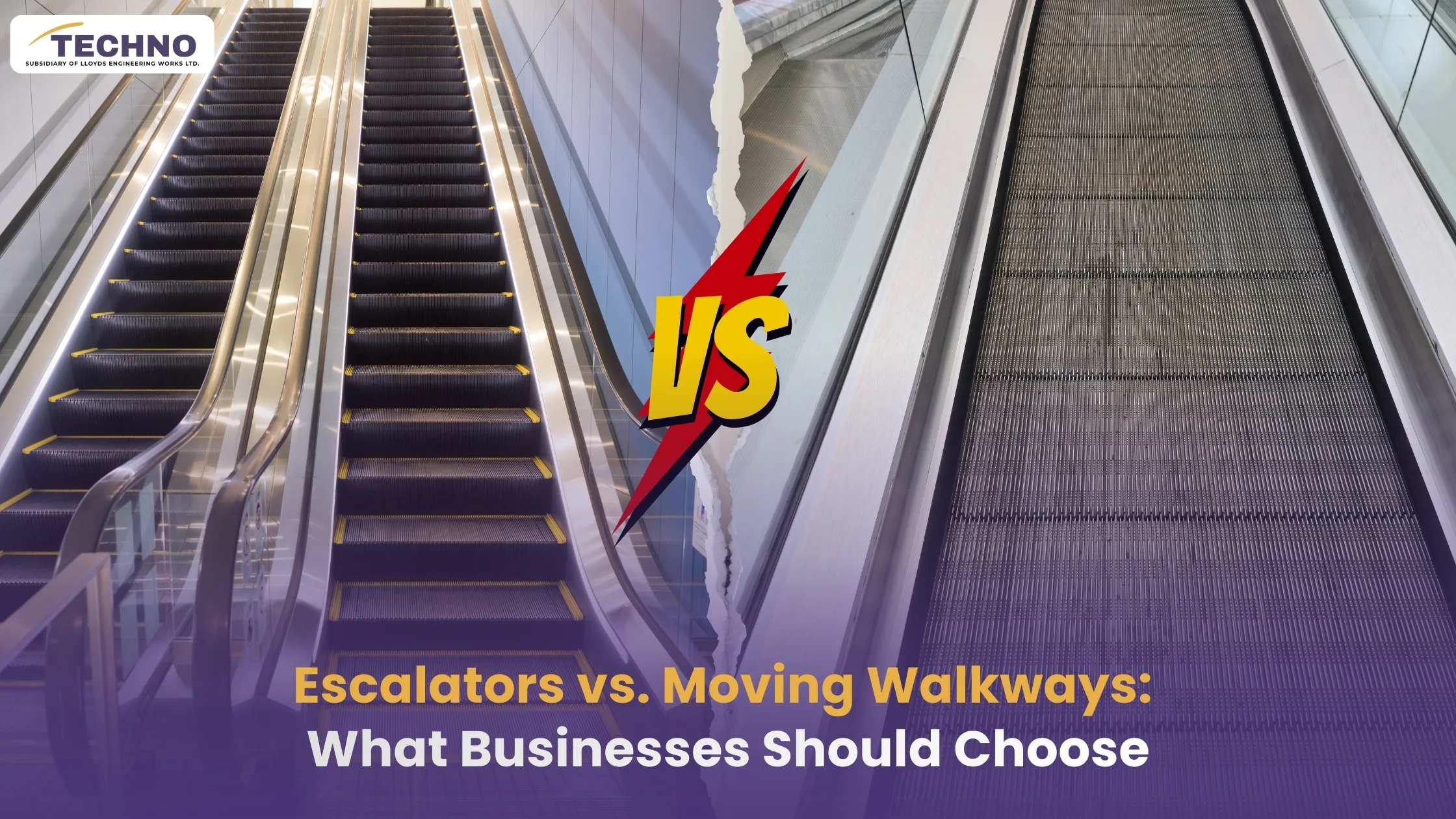
The discourse around the escalator vs moving walkway begins with direction. Escalators transport vertically. Moving walkways manage horizontal flow. That sounds simple, yet architecture complicates everything. Escalators are directly incorporated into multi-level constructions, including loads of 2000-4000kg, speed of 0.5m/s and +-0.2mm manufacturing liberality of arrangement. Walkways reach outward, typically 50-100 meters, with traction systems of belts.
Field evidence shows escalators excel where visual progression matters, particularly in retail environments. Walkways dominate when distance fatigue appears. What’s evident from data is consistency: escalators serve floors; walkways serve corridors.
As a Top elevator manufacturer in India, Techno Elevators designs both systems with distinct mechanical logic, not interchangeable thinking, because application mismatch drives long-term inefficiency.
Pros and Cons of Installing Escalators in Commercial Spaces
The default vertical circulation will be commercial escalators. Their speed is 1,500-2,000 people per hour and there are no waiting periods. That continuity supports retail behaviour and office rush patterns. Escalators also compress vertical travel into compact footprints, protecting leasable space. Aesthetic integration helps; architects favour their visual pull.
Cost matters significantly. Escalator installation cost typically ranges from ₹35-50 lakhs for standard units, climbing higher for complex rises. Energy draw sits at 8-12 kW. Maintenance isn’t light either.
The escalator safety features minimise the hazards and yet the accidents are 0.8 injuries in a million rides. Practice reveals nuance. The commercial escalators can provide value; however, they can only be made when the level of traffic density warrants the increased operational load. Benefits of Moving Walkways at High-Foot Traffic Areas.
Advantages of Moving Walkways in High-Traffic Areas
Airport moving walkways exist for a reason. Distance drains energy. Walkways restore it. Throughput reaches 2,000- 2,500 people hourly in continuous flow, which is better than the escalators in flat planes. The energy use is reduced to 5-8 kW, which is equivalent to 35-45% of savings every year. That difference compounds fast.
Moving walkway benefits extend beyond power. Accessibility improves for luggage carts, wheelchairs, and service equipment. Maintenance cycles stretch longer, with fewer mechanical stress points. Industry observations reveal nearly 78% of airports prefer walkways for primary corridors.
As a top elevator manufacturer in India, Techno implements variable-speed control and synchronised handrails, ensuring walkways stay efficient without sacrificing passenger comfort or regulatory compliance.
Cost Comparison: Escalators vs. Moving Walkways
Cost calculators often mislead. The reality differs from theory. The cost of the moving walkaway installation of escalators begins with 35-50 lakhs as a commercial unit and 60-80 lakhs as a high-rise unit. The cost of a moving walkway installation of a 50-meter system costs between 30-45 lakhs, up to a cost of 65 lakhs at 100 meters.
Upfront gaps look narrow. Lifecycle gaps aren’t.
Annual maintenance averages ₹10-15 lakhs for escalators, compared to ₹6-10 lakhs for walkways. Energy adds ₹4-6 lakhs yearly versus ₹2-3 lakhs. Over five years, walkways save ₹15-20 lakhs in high-traffic zones.
As a top elevator manufacturer in India, Techno advises ROI horizons of 5-7 years, not optimistic three-year projections, because hidden costs surface late.
Space and Layout Considerations for Both Systems
Space decides early. Escalators demand a minimum 1.2 m × 5.0 m footprint, pit depths near 1.5 m, and vertical clearance around 2.2 m per step rise. Machine rooms add constraints. Walkways require length instead — typically 1.0 m width across 50 meters — yet avoid separate machine rooms entirely.
Building transport solutions must align with structure, not preference. Vertical vs horizontal transport decisions shape circulation logic permanently. Commercial escalators suit stacked floors.
Walkways suit spread plates. Techno Elevators, which is one of the top manufacturers of elevator in India, believes in layouts followed by equipment as retrofitting is hardly ever a clean exercise.
Energy Efficiency and Maintenance Requirements
Pedestrian conveyors consume energy constantly. Escalators average 2,920-4,380 kWh annually. Walkways settle between 1,825-2,920 kWh. That 35-45% reduction isn’t theoretical; meters confirm it. Smart idle modes help, yet baseline differences remain.
Maintenance tells another story. Escalators need to be lubricated every month, audited on electricity after every 3 months and certified on safety after every one year, which costs 2-3 lakhs a year. Walkways simplify routines — belt inspection, motor checks — closer to ₹1.5-2 lakhs annually.
Moving walkway benefits appear strongest beyond year five. As a top elevator manufacturer in India, Techno integrates IoT alerts, but claims of zero maintenance still don’t hold up.
Safety Features in Escalators vs. Moving Walkways
Safety is a non-negotiable. The safety systems designed on the escalators are anti-slip steps, comb plate monitoring, various emergency stops, seismic sensors and handrail synchronisation to speed. These systems meet EN 81 standards, yet complexity introduces exposure. Data tells a different story: escalators record 0.8 injuries per million rides.
Walkways reduce risk through flat geometry. Slip-resistant belts, yellow edge demarcation, entry guards, and variable-speed zones lower incidents to 0.3 per million rides. That gap matters. As a top elevator manufacturer in India, Techno designs redundancy because no system achieves perfection. Claims otherwise mislead operators and insurers alike.
Recognised repeatedly as a top elevator manufacturer in India, Techno aligns sustainability with uptime because future buildings demand both. Another top elevator manufacturer in India may promise trends. Techno executes them now.
Choosing the Right Solution for Airports, Malls, and Offices
The application decides winners. Airports prioritise distance reduction. Typically, 200 meters of walkway pairs with four escalators. Cost per passenger averages ₹0.45 for walkways versus ₹0.65 for escalators. That’s why airport moving walkways dominate terminals.
Malls tell another story. Retail escalator solutions drive discovery. Around 85% of malls favour escalators, often installing three to four per floor. Budgets hit ₹1.5-2 crores for five-level complexes. Offices land between extremes.
Mixed-use layouts combine both systems for public space transport systems efficiency. As a top elevator manufacturer in India, Techno supports hybrid designs, because singular solutions rarely fit complex buildings.
Passenger Flow and Convenience in Vertical vs. Horizontal Transport
Passenger psychology shapes flow. Escalators move 1,500-2,000 people hourly, covering three to four floors in 45-90 seconds. Visibility matters; progress feels tangible. Mall studies show 15-20% dwell time reduction.
Walkways handle 2,000-2,500 people hourly in steady streams, covering 100 meters in three to five minutes. Exertion drops 40-50%. Elderly passengers prefer them. Parents do too. Vertical vs horizontal transport isn’t about speed alone; it’s about comfort perception. Techno Elevators, a top elevator manufacturer in India, models flow using real behaviour data, not assumptions.
Future Trends in Commercial Vertical and Horizontal Mobility
Mobility systems become silent between 2026 and 2030. AI flow optimisation is a real-time adjustment of speeds of 0.5-0.8 m/s. Predictive maintenance indicates failures three months in advance with a high effectiveness of 82%. Autonomous cleaning uses UV-C cycles nightly. Manufacturing adopts 60% recycled content.
As a top elevator manufacturer in India, Techno Elevators already deploys IoT monitoring across public space transport systems. That leadership isn’t branding; it’s operational.
Adapting to the evolving requirements of the fast-paced business environment for high convenience, better functionality & adequate safety is a must for …