Evolution of Lift Manufacturing Over the Years
Lift manufacturing rarely followed a straight line. The initial systems were based on hand assembly, hand craftsmanship and poor tolerances. Mechanization brought in repeatability, but bottlenecks were still there.
Automation changed the tempo. AI changed the logic. The only clear thing is progression as opposed to disruption. The contemporary Elevator Manufacturing Company exists within layered systems that are characterized by machines talking, data flows, and human control that refines the results.
Manufacturing data shows that Industry 4.0 protocols had achieved 78% adoption by 2024, which was contributed to by robotics, connected tooling, and analytics-based scheduling.
Techno Elevators reflects that curve. Over 30+ years, production shifted from hand-fitted components to automated lines operating within ±0.2mm tolerance. That transition didn’t remove complexity. It redistributed it.
Full automation remains impossible. Yet AI-assisted production consistently delivers 99.2% quality benchmarks. The reality shows evolution never pauses. It compounds.
Role of Automation in Modern Elevator Production
What Automation Does
Automation reshapes lift manufacturing trends at scale. Cable assembly lines now operate at 95% robotic throughput. Welding systems hold ±0.2mm accuracy. Flags of quality are real-time and indicate deviation before defects spread. The cycle periods were reduced to 16 days as compared to 28 days. That’s not theoretical. That’s operational math.
Automation matters. Profoundly. When CNC machines synchronize with vision systems and torque sensors adjust dynamically, consistency becomes achievable. It becomes the default.
Current Adoption Rates
By 2024, 78% of manufacturers had implemented automation across the world. India is marginally lower at 65%, but the growth rate increases every year.
Techno Elevators ranks among early adopters, integrating robotics in assembly, inspection, and finishing. For any Elevator Manufacturing Company, automation isn’t optional anymore. It’s a no-brainer requirement.
How AI Is Transforming Lift Design and Maintenance
AI in Design and Engineering
AI in elevators redefines design logic. Generative algorithms test thousands of configurations before metal meets machine. Load simulations now hit 98% accuracy. Component lifecycle predictions inform material choices. Design cycles compress from 60 days to 20. Often faster.
Or more precisely, AI removes guesswork. The engineers do not make decisions based on intuition but on probability.
Predictive Maintenance and Monitoring
Predictive maintenance system examines the vibration signals, load signals, hydraulic pressure indicators, and braking performance in parallel.
Defect prediction accuracy reaches 82%. Failures surface six months early. Downtime drops 75%. Savings reach ₹10–25 lakhs per installation. No system achieves perfection. That’s why redundancy exists.
Sustainable Materials and Eco-Friendly Elevator Solutions
Sustainable lift design has affected procurement rather than branding. Recycled steel content averages 60%. Bio-based lubricants see 40% adoption. Single-use plastics fell 80%. Carbon footprint dropped 35% since 2020 across compliant facilities.
Material Innovation
316L stainless steel dominates corrosion-prone environments. Composite components minimize the weight reduction without loss of strength. Biodegradable hydraulic fluid substitutes for mineral oils. Certified sourcing tracks accountability. Eco-friendly elevators emerge from disciplined material science, not slogans.
Lifecycle Analysis
Manufacturing emissions fall 40%. In regenerative systems, the level of operational emissions goes to zero. Recycling done at the end of life attains 95% of material recovery. Techno Elevators considers the lifecycle thinking in each project. Sustainability isn’t decorative. It’s structural.
Energy-Efficient Elevator Systems for the Future
Energy-efficient elevators quantify progress. Regenerative drives deliver 40–45% energy reduction. LED lighting cuts power use by 60%. Smart traffic management reduces stops 25%. Standby consumption drops 80%.
IoT-enabled systems track consumption in real time. Demand-based operation aligns motion with occupancy. Integration with building management systems closes the loop. For any Elevator Manufacturing Company, energy efficiency shifts from compliance to competitiveness. Energy savings don’t argue. They accumulate.
Smart Elevators: Connectivity and IoT Integration
IoT Connectivity Features
Smart elevator technology depends on constant visibility. Systems provides 24/7 diagnostics, cloud diagnostics, mobile diagnostics, and predictive diagnostics. Integration: 50 plus building platforms. Data doesn’t sleep.
Smart Elevator Benefits
Intelligent lift systems achieve 99.2% uptime. Emergency response times compress to two hours. Maintenance scheduling becomes data-driven. Passenger comfort adjusts dynamically. Techno Elevators applies connectivity selectively, avoiding noise while amplifying signal.
Robotics and Advanced Manufacturing in Elevator Production
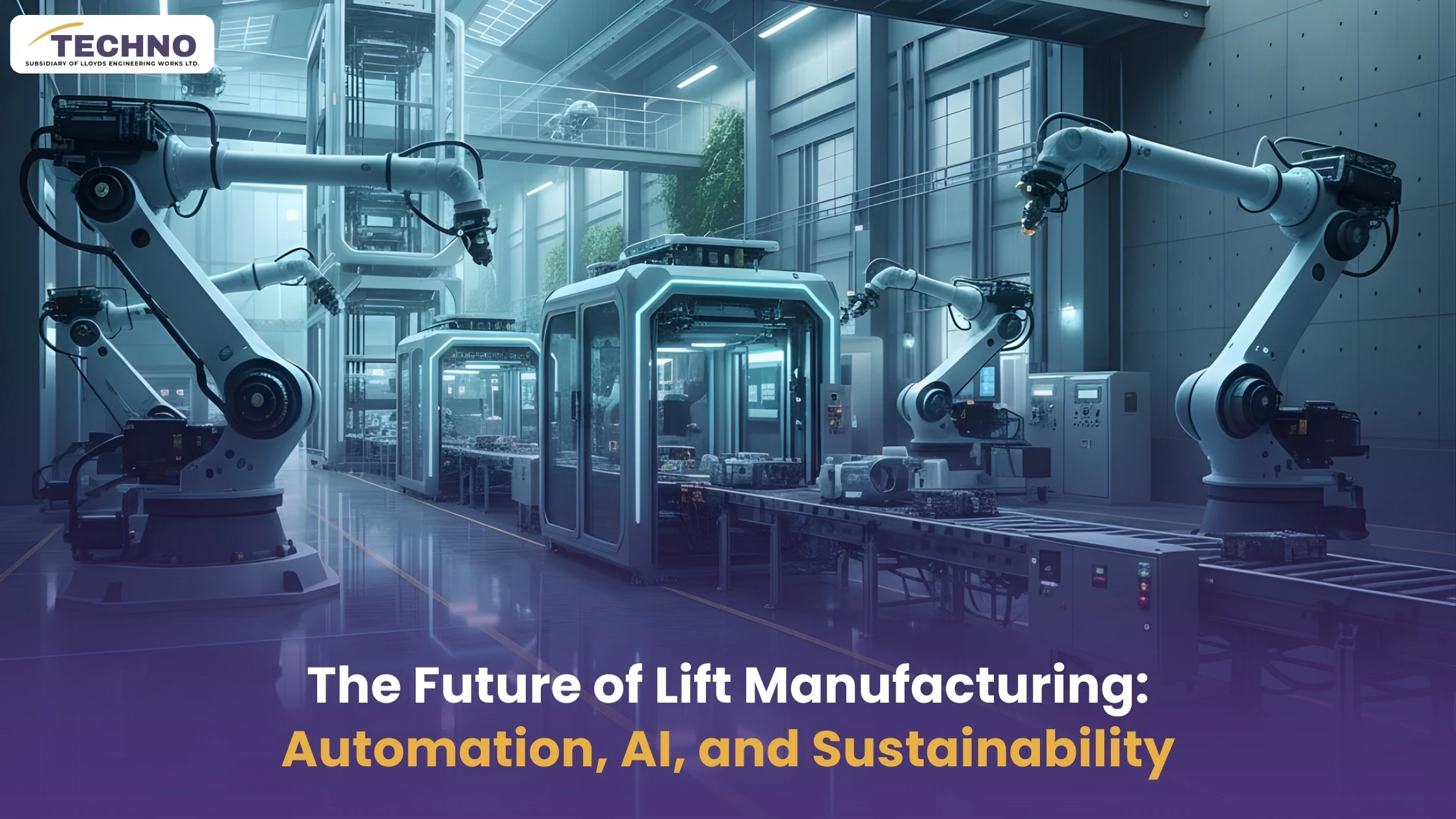
Robotics in lift manufacturing handles heavy lifting. Cable assembly reaches 95% automation. Welding achieves ±0.3mm precision. Painting lines report zero visible defects. AI vision systems inspect every unit.
Digital twins simulate production virtually. Additive manufacturing produces custom components rapidly. Collaborative robots align with human teams. Metrology automation enables 100% inspection. Robotics don’t replace expertise. They scale it.
Safety Innovations in Automated and AI-Driven Lifts
AI-enabled safety systems monitor variation in real time. Predictive brake analysis prevents failures. Emergency response algorithms optimize outcomes. Overload protection activates at 110% capacity.
Redundant control systems remain standard. Seismic detection protects during earthquakes. Fire-resistant materials meet EN 81-72 norms. Emergency descent operates at 50% capacity. Techno Elevators reports zero critical failures over five years. That record isn’t accidental. Lift Innovation 2026 prioritizes prevention over reaction.
Cost Benefits and ROI of Modern Lift Technologies
Automation carries premiums. Automated elevators systems cost roughly 20% more than manual builds. Smart systems add another 15%. Payback arrives within three to five years.
Maintenance costs drop ₹5–8 lakhs annually per lift. Downtime prevention saves ₹2–4 lakhs. Energy efficiency adds ₹3–6 lakhs. Productivity improves 25%.
Manual manufacturing averages ₹45 lakhs. Automated AI systems reach ₹52 lakhs. Five-year savings range ₹20–35 lakhs. The future of lift industry economics rewards foresight.
Trends Shaping the Future of the Elevator Industry
Lift innovation 2026 accelerates convergence. AI-powered personalisation identifies destinations. Carbon neutrality targets net-zero manufacturing by 2028. Hyperlocal production clusters reduce logistics emissions. Circular economy models push 100% recyclability.
Autonomous inspections deploy drones for cable monitoring. Quantum computing explores ultra-fast optimization. Blockchain tracks component lifecycles. Biophilic design integrates nature into cabins.
Techno Elevators advances pan-India automation, zero-emission operations, and AI-first design. Green elevator solutions won’t be optional. They’ll be baseline. The Elevator Manufacturing Company that adapts fastest sets the ceiling.

Make Every Ride Count! Elevators are More Than Just a Lift—Master the Do’s and Don’ts of Elevator Etiquette for a Smoother, Polite …