
Introduction
Space is expensive – whether you’re building a villa in Pune, a mid-rise apartment block in Bengaluru, a warehouse in Indore, or a retail complex in Ahmedabad. Every square foot you reclaim either generates additional revenue or enhances utility. That’s why many developers, homeowners, and even facility managers keep asking the same question: How do we add vertical mobility without sacrificing usable area or blowing up the budget?
A surprising number assume “MRL” automatically means traction. Not true. Machine Room-Less Hydraulic lifts exist, and they’ve matured into one of the most dependable solutions for 2-6 storey structures – homes, offices, hospitals, showrooms, and even light industrial sites. The conversation shifts quickly once one understands how MRL hydraulic elevators simplify installation, reduce operating costs, and cut spatial overhead.
For building owners and developers balancing ROI pressure with occupant experience, these systems hit a sweet spot. And for facility managers who prioritize uptime, the reliability profile is even more compelling.
Understanding MRL Hydraulic Elevators Operate
What Makes MRL Hydraulic Systems Different?
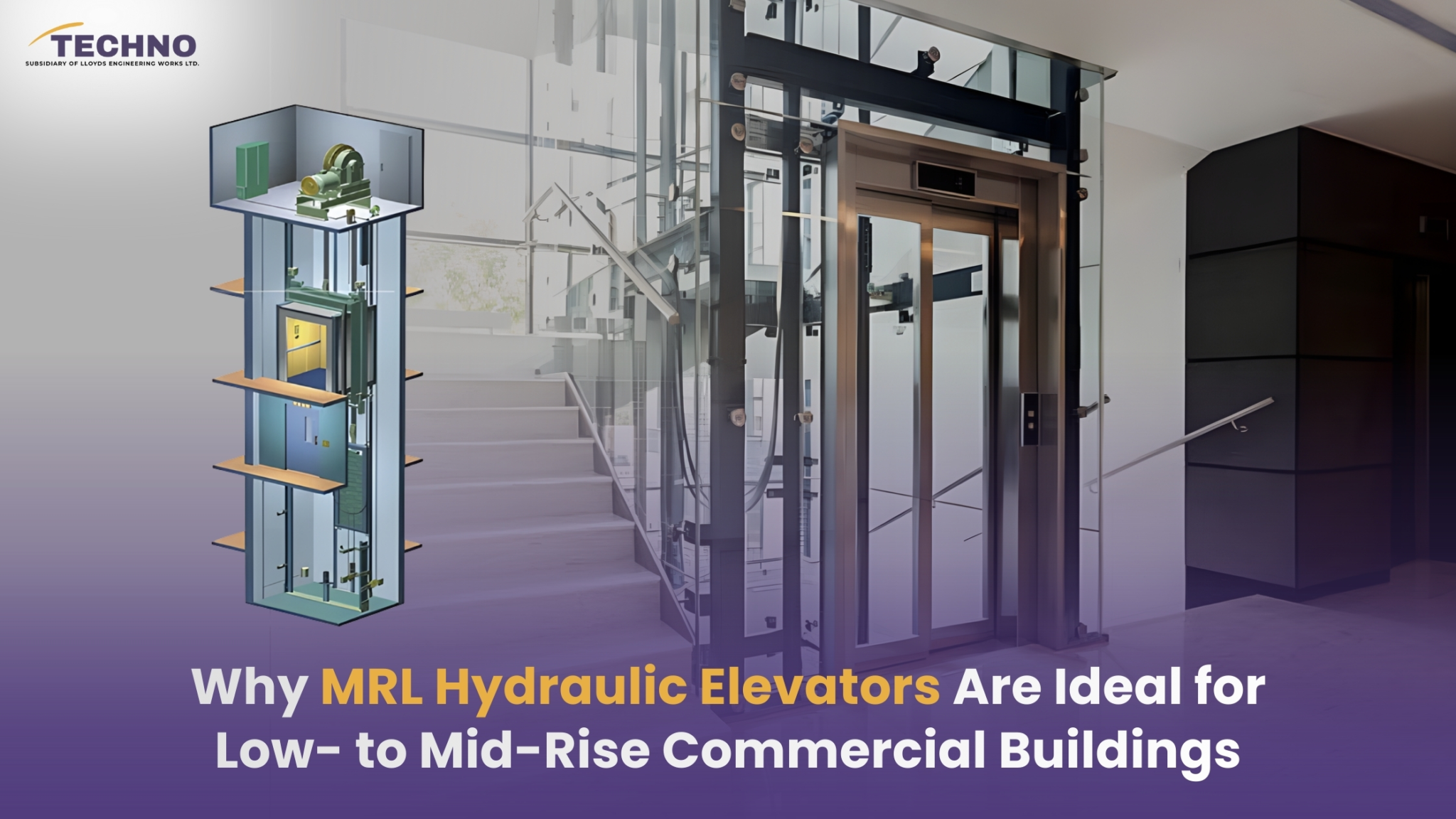
MRL means Machine Room-Less – a compact architecture that removes the external machine room used by older hydraulic lifts. Instead of dedicating 40-70 sq ft to machinery, the hydraulic pump and controller are housed in a compact cabinet or integrated pit-side enclosure. It’s clean, contained, and surprisingly quiet.
This shift matters for every segment. A homeowner can free up a utility room. A warehouse can use the space for storage. A hotel can convert that area into revenue-generating operations. And for developers pushing for maximum saleable area, “space released” directly affects project value.
MRL hydraulic elevators offer exactly this advantage without compromising load capacity or safety.
How They Operate in Practice
The operating logic is simple but elegant. Pascal’s principle – pressure applied to a confined fluid is distributed uniformly – drives the car upward. A pump pushes hydraulic fluid into the cylinder; on the way down, gravity does the work, not the motor. That “pump up, gravity down” cycle is ideal for low-rise and mid-rise buildings where travel distances stay reasonable.
Modern MRL elevators using hydraulic systems are refined enough to serve residential villas, commercial offices, and even certain goods-movement environments where traction would be overkill.
Space-Saving Design Advantages for Commercial Buildings
In typical commercial projects, a conventional hydraulic machine room can steal 50-100 sq ft. At rental rates of ₹80-₹150 per sq ft per month in many Tier-1 micro-markets, that’s ₹48,000-₹180,000 annually in lost leasable value. MRL designs remove that penalty entirely.
Space-saving elevators give architects and builders more freedom. Residential projects can’t tuck the equipment into a wall-side cabinet. Commercial developers can reclaim an extra office room, storage bay, or display zone. Industrial facilities can use the same freed area for utility racks or spare parts inventory.
One developer in Pune reported recovering 65 sq ft by switching to MRL hydraulics – enough to add a small manager’s cabin. It’s a straightforward example of how smart engineering increases functional square footage without altering building footprints.
Energy Efficiency and Reduced Operating Costs
The Energy Economics
Hydraulic lifts operate differently from their traction counterparts. Traction systems rely on counterweights and motors that work both ways – up and down. Hydraulic systems only consume motor power on the upward run; descent is gravity-assisted, cutting overall energy usage.
In real installations, energy-efficient hydraulic elevators often consume 30-40% less energy than comparable MRL traction units in low-rise conditions. LED cabin lighting and standby-mode control units further push savings.
This makes a difference not only for commercial building owners but also for hotels, small hospitals, and even premium homeowners who want an eco-friendly lift without adopting industrial machinery.
Calculating Your Long-Term Savings
Consider a standard 4-storey office building: annual elevator energy costs might be ₹45,000-₹60,000 with traction, but MRL hydraulics typically land in the ₹28,000-₹35,000 range. Over ten years, that’s ₹1.5-₹2 lakh saved – before factoring in reduced maintenance.
Energy-efficient hydraulic elevators make long-term budgeting easier for facility managers, especially those managing multiple residential towers or mixed-use sites. Lower complexity equals fewer surprises.
Comparing MRL and Traditional Elevators: What You Need to Know
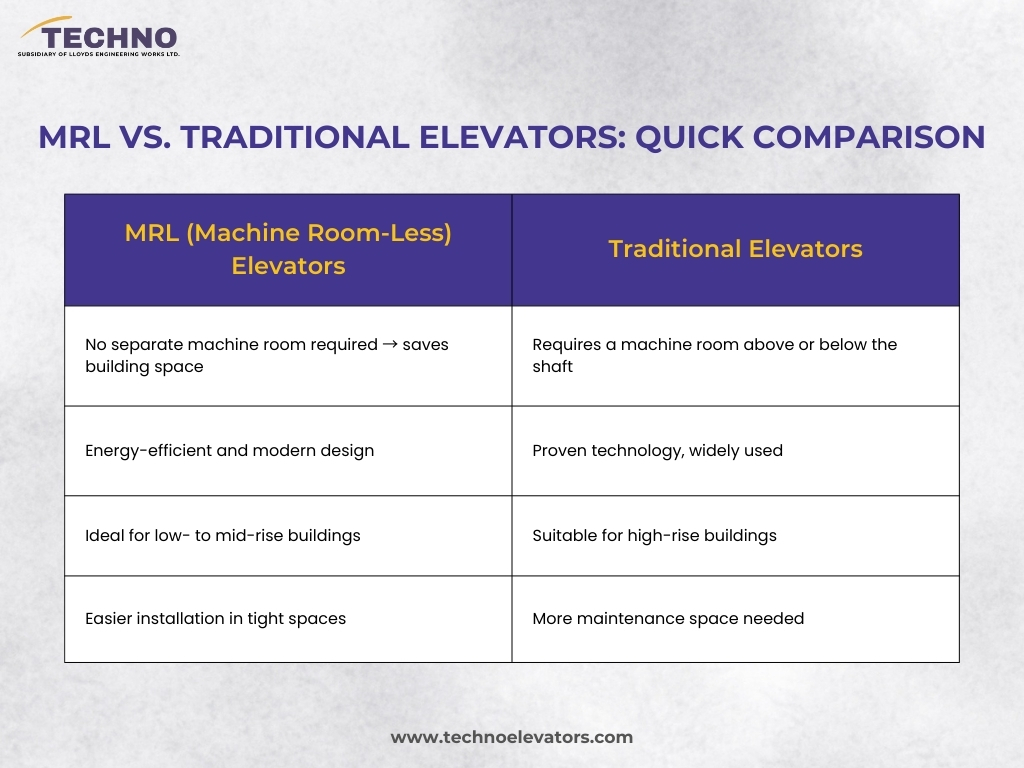
Cost-Effective Alternative to Traditional Elevator Systems
Initial Installation Costs
MRL hydraulic systems tend to be 15-25% more economical than MRL traction units. The engineering is simpler: no counterweights, no complex hoisting machines, fewer alignment constraints, and minimal overhead structure requirements.
This appeals to every segment:
- Homeowners save on civil modifications.
- Developers reduce CAPEX per unit.
- Warehouses avoid structural strengthening.
- Commercial builders maintain budget flexibility.
Cost-effective commercial elevators are especially valuable for mid-scale offices and retail complexes where every capital decision compounds across multiple units.
Maintenance & Long-Term Economics
Hydraulics have fewer parts, predictable service cycles, and readily available spares – especially within the Techno Elevators ecosystem across India. The commercial escalators with hydraulic technology are low-rise elevators with an average of 5-7 years of operation with regular maintenance only.
Facility managers appreciate the simplicity: fewer sensors to calibrate, fewer mechanical adjustments, and stable performance. That’s essential for hospitals and residential towers where downtime is unacceptable.
Safety Features & Regulatory Compliance
Built-In Safety Mechanisms
Hydraulic lifters are designed with built-in protection. The overload conditions are avoided with the help of pressure-relief valves. Manual lowering mechanisms ensure that the lift can descend safely during power failures. Emergency descent systems activate without electrical dependency, giving peace of mind to homeowners, hospitals, and commercial operators.
Industrial sites benefit too: hydraulics are naturally robust under shock loads and intermittent heavy-duty cycles.
Meeting Indian & International Standards
MRL hydraulic elevators align with global benchmarks such as ISO 1828 and relevant EN and BIS codes. Techno Elevators applies a Zero Downtime philosophy, meaning audits, checks, and preventative servicing are baked into every installation.
This compliance profile gives developers the assurance they need for approvals and gives facility managers confidence in long-term performance.
Simplified Installation and Maintenance for Commercial Spaces
Installation for MRL hydraulics is straightforward. Compact equipment requires only a modest pit, minimal headroom, and no overhead machine room. That reduces civil work – an advantage for retrofit home lifts, new residential towers, commercial sites, and even warehouse expansions.
Timelines shrink, too. A typical installation might complete 10-15% faster than traction systems because alignment and counterweight balancing aren’t required. For builders, that means faster handovers. For homeowners, less disruption. For industrial operations, reduced downtime.
Maintenance is equally predictable, with clear intervals for inspection, oil checks, and controller diagnostics. Techno Elevators’ on-site service teams ensure that elevator installation for offices, apartments, and industrial sites remains consistent across regions.
Design Flexibility and Customization Options
Cabin Customization
Residential buyers want elegance. Commercial owners want durability. Industrial users want rugged practicality. MRL hydraulics accommodate all three. Customization opportunities are vast, starting with stainless steel finishes, glass cabins, anti-scratch finishes, LED lights, and hospital-grade interiors.
Technical Adaptability
Door configurations (center opening or side), capacities ranging 630-2500 kg, and variable speeds make it easier to match specific needs. This plays a crucial role in commercial building vertical transport, whereby the flow of traffic, ease of access, and comfort of consumers are of the highest priority.
Real-World Examples: MRL Hydraulic Elevators in Offices and Retail
Scenario 1 – Boutique Office Complex (Mumbai)
A 4-storey, 12,000 sq ft complex installed two MRL hydraulic lifts. Eliminating the machine room freed 800 sq ft, later leased to an IT startup, generating ₹8 lakh/year in extra income. Energy bills dropped from ₹4.5 lakh to ₹2.8 lakh annually. Over five years, operations reported zero major downtime incidents.
Scenario 2 – Retail Plaza (Ahmedabad)
A 5-storey retail hub needed smooth people flow without compromising storefront space. MRL hydraulics allowed installation to finish three weeks ahead of schedule, helping tenants open before Diwali season. For developers, earlier occupancy meant faster revenue realization.
Popup Trends: Smart Technologies in Hydraulic Systems
Smart hydraulics are going beyond imagination. IoT-based monitoring offers real-time insights into usage, temperature patterns, oil health, and door cycles. Remote diagnostics help service teams respond before issues escalate.
Energy dashboards track consumption, useful for commercial owners and for residential societies monitoring shared expenses. Integration with building management systems allows central control – valuable for hotels, hospitals, and industrial parks.
Common Misconceptions of MRL Hydraulic Elevator
Some still believe hydraulics are slow or noisy. Modern systems are significantly refined, with smooth ride quality and low mechanical sound. “MRL means traction only” is another misconception – MRL hydraulic elevators have been standard in low- to mid-rise buildings for years.
Maintenance isn’t expensive; in fact, fewer components translate to lower lifecycle costs. And while hydraulics don’t suit tall skyscrapers, they’re exactly right for the 2-6 storey segment across residential, commercial, and industrial use cases.
Here’s what’s coming:
AI Crowd Prediction
Escalators that adjust speed or direction based on predicted crowd flow – much like Google Maps predicting traffic before you reach it.
Robotic Inspection Tools
Small robots that travel inside the escalator at night, checking parts with precision cameras and sensors.
Self-Learning Safety Systems
Escalators that learn from their own usage data and adjust the operation to reduce internal wear.
Enhanced Mixed-Reality Maintenance
Technicians may soon wear AR glasses that highlight faulty parts instantly.
Conclusion
MRL hydraulic elevators strike a practical balance for developers, homeowners, commercial owners, and industrial clients. They conserve space, reduce energy consumption, reduce costs of installation, ease maintenance, and provide the reliability that is required in modern-day properties. It makes good business sense when you consider hydraulic lifts (business perspective): reduced CAPEX, predictable OPEX, and additional space to work with make the ROI equation a very attractive one.
When you are planning a low-mid-rise building or improving one, talk to a manufacturer who can comprehend the intricacies of your building, your car-traffic pattern, and your operating priorities in the long term. Techno Elevators has developed a successful collaboration with its Zero Downtime philosophy and impeccable track record in residential, commercial, and industrial projects.
Every time you are planning an elevator to be installed in either a residential or commercial building, you are making a choice …
